How to Fix Bullet Journal Mistakes Without Starting Over
Smudges, misspelled headers, crooked lines, wrong dates and layouts that do not work: practical ways to cover or redesign each one, and habits that prevent the next.
Bullet journal mistakes are part of working in ink: a smudged line, a misspelled header, a calendar that starts on the wrong weekday. None of them is a reason to tear out a page or abandon the notebook.
Most errors can be covered, absorbed into the design or simply crossed out. The fixes below are sorted by the kind of mistake, starting with the smallest.
Decide first whether it needs fixing
A notebook used for planning is a working tool. A single neat line through a wrong word, with the right word written beside it, is a complete fix and takes two seconds.
Save the more involved repairs for errors that make a page harder to use, such as wrong dates, or that will catch your eye every time you open the spread, such as a title page with a spelling error.
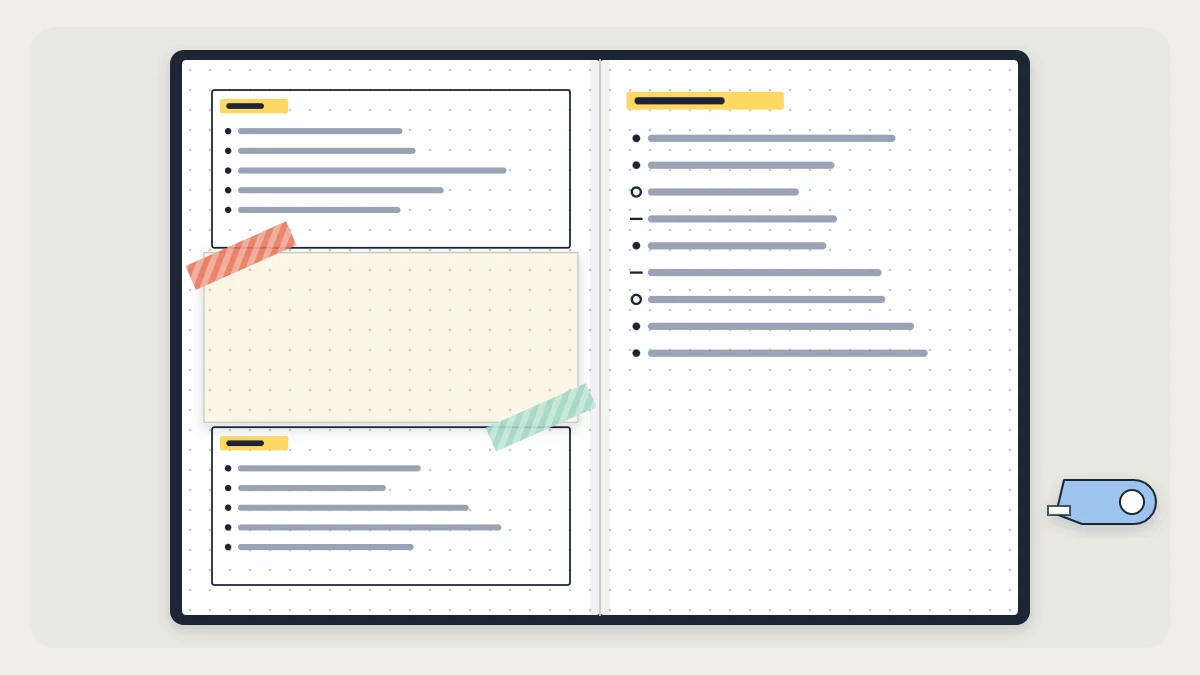
Four fixes that cover most errors
- Correction tape. A dry white strip you can write on immediately. Best for a word or a short line.
- A paper patch. A piece of matching paper glued over a box or a section. Best for larger areas.
- A washi tape strip. Decorative tape laid over an error near an edge or along a line.
- A redesign. Turning the error into a doodle, a thicker line or a border so that it looks intended.

Smudges, blots and stray marks
Small marks are the easiest to absorb into the page.
- A blot or dot of ink can become the center of a small flower, a leaf or a filled circle. Repeat the same shape in one or two other corners so it reads as decoration. The guide to simple bullet journal doodles has shapes that take a few strokes.
- A smeared line can be hidden under a wider line. Go over it with a thicker pen, around 0.8 mm, or with a highlighter band.
- A smudge in open space can be covered with a strip of correction tape. If your paper is ivory rather than white, test the tape on a back page first, because a bright white strip may stand out more than the smudge did.
Wait until the ink is completely dry before attempting any of these. Working on a wet smudge spreads it.
Misspelled headers and wrong dates
Headers are large, so a wrong letter is hard to disguise by writing over it. Cover the whole header instead.
- Cut a strip of paper slightly larger than the header. A page from the back of the same notebook matches the color and dot pattern.
- Write the corrected header on the strip before gluing, so a second slip costs you nothing.
- Stick it down with a glue stick or double-sided tape. Liquid glue can warp the page.
- Frame the patch with a thin pen line, or hold two edges with short pieces of washi tape, so it looks like a label.
For a single wrong date in a calendar, a small square of correction tape is enough. If a whole row or the starting weekday is wrong, patch the entire grid area with one piece of paper and redraw it; correcting a dozen cells one by one looks messier than one clean patch.
Headers go wrong less often when the style relies on shapes rather than careful lettering. Several are shown in the article on bullet journal headers.
Crooked and misplaced lines
A line that drifts off the dots cannot be erased, but it can be thickened until the wobble disappears.
- Thicken it. Lay the ruler along the correct path and draw a second line touching the first, then fill the gap. The result is one bold, straight line.
- Double it. Draw a parallel line one square away and treat the pair as a decorative double border. Repeat it on the opposite side of the box for balance.
- Decorate over it. Turn the line into a row of dashes, dots or small leaves.
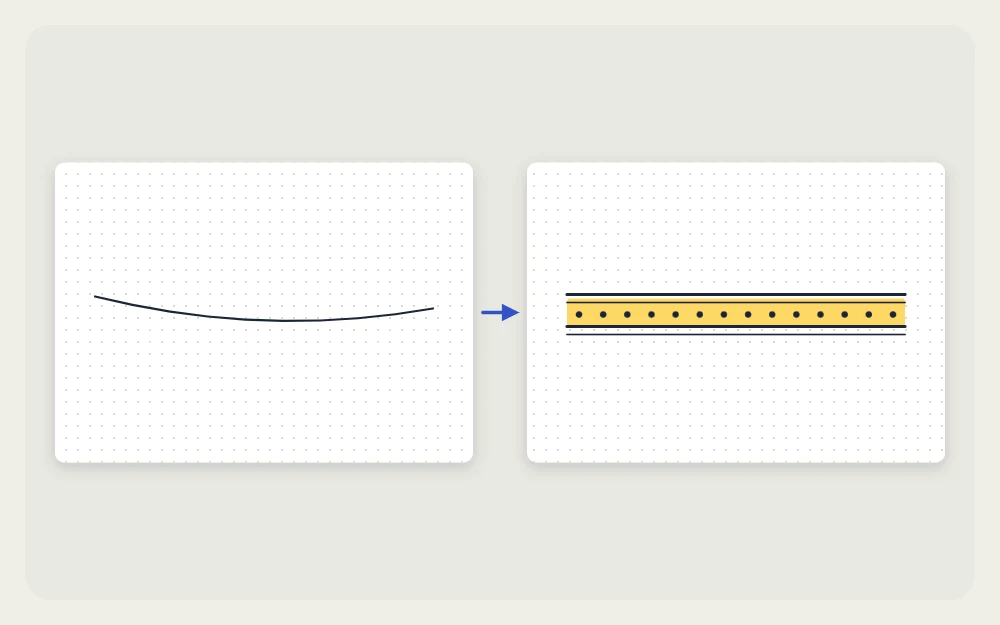
More patterns that can sit on top of a faulty line are collected in bullet journal borders and dividers.
A line drawn in the wrong place entirely, such as a column divider one square too far left, is better covered. A strip of washi tape hides it, and you can rule the correct line beside the tape.
A layout that does not work
Sometimes the error is the whole page: boxes too small to write in, or a spread you stopped using after three days. There are three ways forward.
- Turn the page. Draw a better version on the next spread and leave the old one as it is. This is the fastest fix, and the old page costs nothing by staying.
- Glue two pages together. If the faulty layout is on both sides of one sheet, or backs onto a blank side, run a glue stick around the edges and press it against the neighboring page. The sheet becomes thicker, and the error is sealed inside.
- Cover the full page. Glue a sheet of paper cut to size over it and start again on the new surface.
Watch out
Avoid tearing pages out of a sewn notebook. Each sheet is folded around the spine, so removing one page loosens its partner in another part of the book.
Habits that prevent the next mistake
A few small routines remove most errors before they reach ink.
- Pencil first. Sketch boxes and headers lightly, check them, then ink and erase.
- Count twice. Count the squares on your own page and write the totals in pencil in the margin before dividing the space.
- Check the calendar. Confirm the first weekday and the number of days before drawing any monthly grid.
- Space out header letters. Count the letters, mark the middle of the space and write the middle letter first, working outward.
- Keep the ruler clean. Wipe its edge after each inked line, and let ink dry before moving the ruler across it. More technique is in the guide on how to use a ruler in a bullet journal.
Tip
Keep a few spare strips of paper from the back of your notebook tucked into the cover pocket. A patch that matches the page is ready whenever you need one.
Frequently asked questions
Should you tear out a page with a mistake?
It is better not to. In a sewn notebook each sheet is joined to another page elsewhere in the book, so removing one can loosen the other and weaken the binding. Covering the page with a paper patch, or gluing it to its neighbor, hides the error and keeps the notebook intact.
Does correction tape work on dot-grid paper?
Yes, with two limits. The tape covers the dots, so the corrected area is blank, and its bright white may not match ivory or cream paper. Use it for small areas, write on it with a fineliner or ballpoint, and test first, since some gel inks stay wet on the surface.
How do you fix a monthly calendar with the wrong dates?
For one or two wrong numbers, cover each with a small piece of correction tape and rewrite it. If the starting weekday is wrong, every date is shifted, so glue one paper patch over the whole grid and redraw it. Confirm the weekdays against a calendar before inking the second version.