Seasonal Bullet Journal Themes for Spring, Summer, Fall and Winter
Original theme ideas for each season: three easy motifs built from basic shapes, a three-color palette, and the three places to use them so your regular layouts stay exactly as they are.

Seasonal bullet journal themes give you a ready answer to “what should this month look like?” without asking you to redesign anything. Pick a few motifs and three colors that suit the time of year, repeat them in a few fixed spots, and your usual layouts carry on underneath.
The ideas here are built from circles, ovals, triangles and straight lines, so they work even if you would not call yourself someone who draws.
How a theme works: three motifs, three colors, three places
A theme is a small set of repeated choices, not a new page design. Limit it to:
- Three motifs: simple drawings you can repeat at any size.
- Three colors: a main color, an accent and a neutral for lines and writing.
- Three places: the spots on a spread where the theme appears, and nowhere else.
One season lasts about three months, which is long enough to get bored of a single drawing. Keep the palette for the whole season and let a different motif lead each month. The pages stay related, and each month still looks new.
Spring and summer motifs
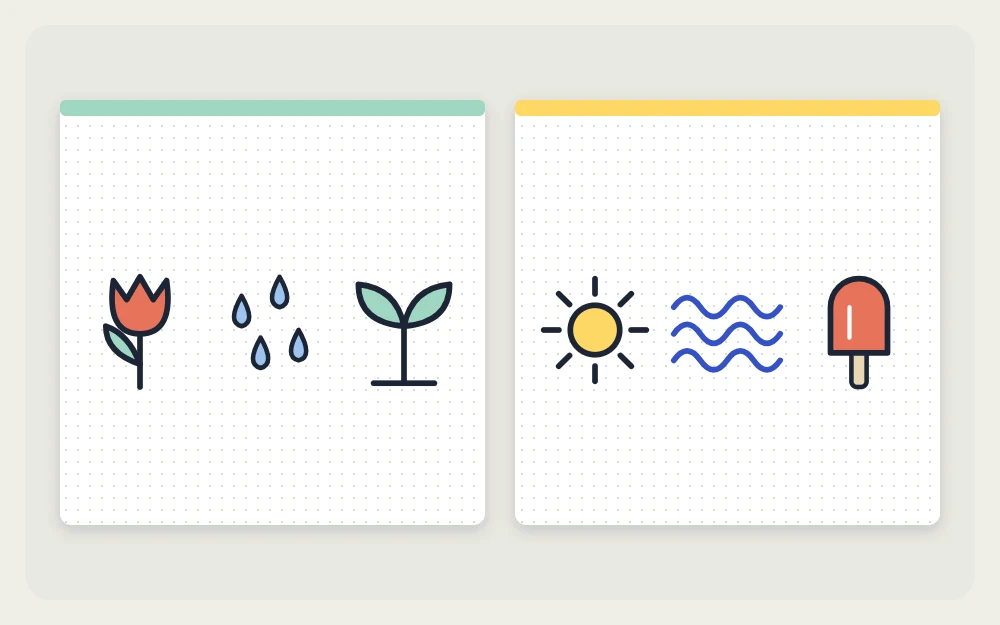
Spring
- Tulip: a U-shaped cup with three points along the top, on a straight stem with two long pointed leaves.
- Raindrops: small teardrops, each a point above a rounded base, scattered in groups of three.
- Sprout: a short curved stem with two oval leaves, rising from a low mound.
Spring motifs are light and open, so draw them as outlines and fill only one part, such as the tulip cup, with color.
Summer
- Sun: a circle with short straight rays, alternating long and short.
- Waves: two or three rows of repeated shallow curves, which also make a good divider.
- Ice pop: a rectangle with a rounded top on a short stick, with one diagonal line for a highlight.
Summer shapes can take solid fills. A fully colored sun in a corner is quicker to draw than an outlined one and reads clearly at a small size.
Fall and winter motifs
Fall
- Leaf: a pointed oval with a center vein and three short veins on each side.
- Acorn: an oval with a rounded cap covering its top third, cross-hatched, and a tiny stalk.
- Mushroom: a half-circle cap on a short, slightly widened stem, with two or three dots on the cap.
Scatter fall leaves at different angles, as if they have landed on the page. Three leaves in three sizes look more natural than a neat row.
Winter
- Snowflake: three straight lines crossing at the center, with a small V near the end of each arm.
- Mitten: a rounded rectangle with a thumb bump on one side and a striped band at the cuff.
- Pine tree: three triangles stacked and overlapping, on a short trunk.
The snowflake is the easiest motif in the whole set to draw on a dot grid: use a center dot and count 2 squares out for each arm. It scales down to a single square for use as a bullet or tracker mark.

If any of these feel awkward at first, practice them in pencil on a spare page. The stage-by-stage method in simple bullet journal doodles applies to every shape here.
A three-color palette for each season
| Season | Main color | Accent | Neutral |
|---|---|---|---|
| Spring | Soft leaf green | Pale pink | Warm gray |
| Summer | Turquoise | Sunny yellow | Navy |
| Fall | Rust orange | Mustard | Dark brown |
| Winter | Icy blue | Pine green | Charcoal |
Use the neutral for every line and all writing, the main color for headers and larger fills, and the accent in small touches. The reasoning behind that split, and how to test colors on your own paper, is in bullet journal color palettes.
Pale accents such as yellow and pink are for filling shapes, not for outlining them. Draw the motif in the neutral, then color inside it.
Where to use a theme without redrawing your layout
Your weekly and monthly layouts should stay exactly as they are. The theme sits on top in three places:
- The cover page. One large motif, or a cluster of all three, plus the month name. This is the only page where the theme is the main feature. Quick structures to build on are in monthly cover page ideas.
- Headers. One small motif at the end of each main header, about 2 squares tall, with the header bar in the main color. Any of the styles in bullet journal headers will take a motif beside it.
- Corners. One motif in a single corner of the spread, usually the bottom outer one, where there tends to be spare space.
Everything else, including day boxes, lists and trackers, stays in plain neutral lines. That restraint is what makes the three themed spots stand out.
Watch out
Draw the layout first and add motifs last. A doodle placed early often ends up where a box or list needs to go.
Small ways to extend a theme
If you have time and want more, these additions take a minute each and do not change the structure:
- Use the simplest motif as a fill mark in a tracker: a raindrop in spring, a tiny leaf in fall, in place of a colored square.
- Turn a motif into a divider by repeating it along a line, such as a row of waves or a string of small pine trees.
- Shade weekend columns in a pale tint of the main color.
- Draw one motif beside the page number.
Adapting the seasons to your own year
The four sets are starting points, not a calendar you must follow. Seasons fall in different months depending on where you live, and some places have a wet and a dry season instead of four. Match the motifs to what is outside your window.
You can also tie a theme to your own schedule: a school term, a garden’s planting and harvest, or a sports season. The method is unchanged. Choose three shapes you can draw in under a minute each, three colors, and three places to put them.
Tip
Draw your three motifs and three color swatches on a small card and tuck it into the notebook. It saves working out the theme again each time you set up a week.
Frequently asked questions
Does a theme need to change every month?
No. One theme can run for a whole season of about three months. Keeping the same three colors and changing only the lead motif each month gives variety without new planning. Some people keep a single theme all year and others skip themes entirely; the layouts work the same either way.
How long does it take to add a theme to a spread?
With three practiced motifs, roughly five to ten minutes per spread: a header fill, one small motif beside the header and one in a corner. A cover page takes longer, about 15 to 20 minutes, because the motifs are drawn larger and usually colored in.
What if the motifs do not turn out well?
Draw them in pencil first and ink only the lines you are satisfied with. Keeping motifs small, about 2 squares tall, hides wobbles. You can also drop the drawings and carry the theme with color alone: header bars and a border in the season's three colors still read as a theme.