Bullet Journal Supplies: What You Need and What Can Wait
A notebook, one pen and a ruler are enough to begin. Learn how to choose notebook size, ruling and paper weight, and which extras are worth adding later.

The list of bullet journal supplies you actually need is short: a notebook, a pen and a ruler. Everything else on a typical shopping list is optional, and most of it is easier to choose after a few weeks of use.
This guide separates the starter kit from the extras and walks through the three notebook decisions that matter most: size, ruling and paper weight.
The minimum kit
Three items are enough to draw every core page, and a fourth makes the drawing less risky.
- A notebook. Around 100 to 200 pages, in a size you will carry or keep on your desk.
- One pen. A black fineliner or gel pen with a 0.3 mm to 0.5 mm tip writes small without filling in letters.
- A ruler. A clear 6-inch (15 cm) ruler fits inside an A5 notebook and lets you see the dots underneath.
- A pencil and eraser. Not strictly required, but sketching a layout in pencil first saves pages.
With these you can follow the full first setup from page numbers to the first daily log.
Choosing a notebook size
Size decides how much fits on a spread and whether the notebook travels with you. A and B sizes follow the ISO 216 paper standard; US sizes are close but not identical.
| Size | Dimensions | Good for |
|---|---|---|
| A5 | 5.8 x 8.3 in (148 x 210 mm) | The usual choice: portable, with room for a weekly spread across two pages |
| US half letter | 5.5 x 8.5 in (140 x 216 mm) | Very close to A5, slightly narrower and taller |
| B5 | 6.9 x 9.8 in (176 x 250 mm) | Larger handwriting, desk use, detailed monthly grids |
| A6 pocket | 4.1 x 5.8 in (105 x 148 mm) | Lists and daily logs on the go; tight for calendars |
B5 measurements differ a little between manufacturers, so check the listed dimensions. If you are unsure, start with A5: most layout instructions are written for it, which makes them easier to follow square for square.
Dot grid, square grid or lined
Ruling is the pattern printed on the page. The usual spacing for dots and squares is 5 mm.
- Dot grid gives you guides in both directions, yet fades into the background once the page is filled. It suits layouts with boxes, calendars and trackers.
- Square grid offers the same guidance with visible lines. It is the easiest ruling for precise tables, though the lines stay noticeable behind your writing.
- Lined paper is fine for a list-based journal. Vertical lines are harder to place, so calendars and columns take more measuring.
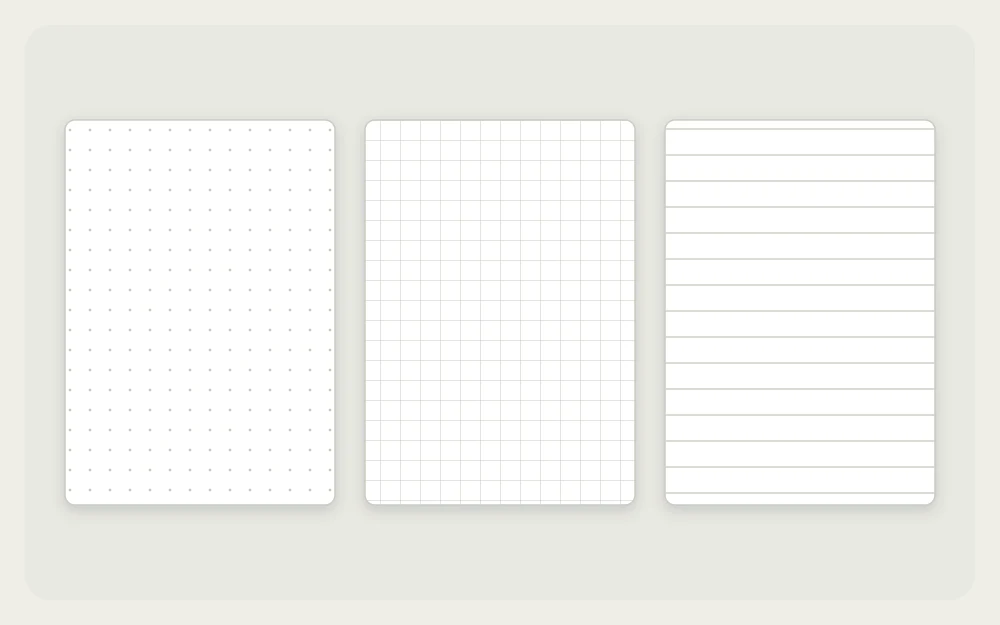
Whatever you choose, count the squares across and down your own page before copying any layout. A typical A5 dot-grid page has roughly 26 to 27 squares across and 38 to 39 down, but margins vary from notebook to notebook.
Paper weight in gsm
Paper weight is given in grams per square meter (gsm). A higher number means a thicker, more opaque sheet. It matters because of two things ink can do:
- Ghosting: writing is faintly visible from the other side of the page.
- Bleeding: ink soaks through and leaves marks on the reverse.
As a rough guide, paper around 80 gsm shows ghosting with most pens and may bleed under markers. Paper around 100 to 120 gsm handles fineliners and gel pens with light ghosting. Paper around 160 gsm takes brush pens and highlighters comfortably, but the notebook holds fewer pages for the same thickness.
If you plan to write with one fine pen, mid-weight paper is plenty. Weight is only half of the picture; the pen matters as much, and the guide to the best pens for bullet journaling covers tip sizes and ink types.
Binding and small details
A few features make daily use smoother. None is essential.
- Lay-flat binding. A sewn spine lets both pages lie flat, so a ruler can cross the middle of a spread.
- Numbered pages. Printed numbers save about ten minutes of numbering by hand.
- Ribbon bookmarks. Two ribbons can mark the current month and the current day.
- Elastic closure and back pocket. Useful if the notebook lives in a bag.
Spiral binding lies flat as well, but the coil interrupts layouts that span two pages.
What can wait
These extras are pleasant to have, but none of them makes the notebook work better as a planner. Add them one at a time, when you notice a real use for them.
- Mild-color highlighters for headers and color coding.
- A second fineliner in a thicker tip, around 0.8 mm, for box outlines.
- A brush pen for larger titles.
- Washi tape for page edges, section markers and covering errors.
- A stencil with circles and small icons, handy for trackers.
- Correction tape, which is one of several ways to fix mistakes on the page.

How to avoid overbuying
The simplest approach is to begin with the minimum kit and use it for about two weeks. During that time, note what you reach for and do not have. A missing highlighter is easy to add; a drawer of unused markers is harder to undo.
When you do add a pen, test it on the last page of the notebook before using it on a spread. Draw a line, fill a small square and check the reverse side once the ink has dried.
Tip
A short clear ruler is the most underrated item in the kit. Learning how to use a ruler on a dot grid does more for tidy layouts than any extra pen.
Frequently asked questions
Is A5 or B5 better for a first bullet journal?
A5 suits most beginners because it is easy to carry and most layout instructions are written for it. B5 gives more room per page and is comfortable for larger handwriting or detailed monthly calendars, but it is heavier and works better as a notebook that stays on a desk.
What paper weight stops pens from showing through?
No weight removes show-through completely, but thicker paper reduces it. Around 100 to 120 gsm copes with fineliners and gel pens with only light ghosting. Around 160 gsm handles highlighters and brush pens. Always test a new pen on a back page first, since ink behaves differently on each paper.
Can you use a lined notebook for a bullet journal?
Yes. The method is mostly short lists, which suit lined paper well. Calendars, columns and trackers take more effort because there are no vertical guides, so you will need to measure with a ruler. If you expect to draw many boxes, dot grid or square grid is easier.